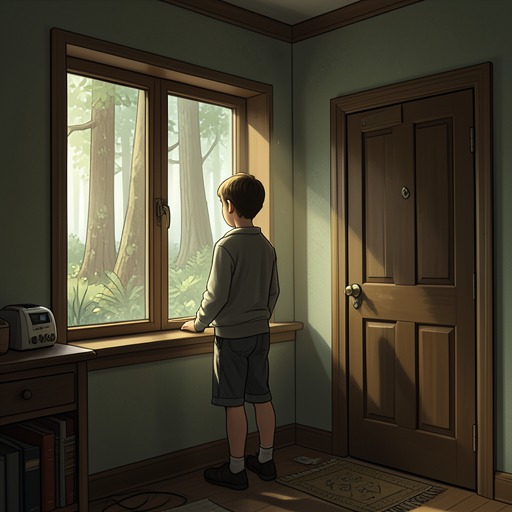
He now carried the cage in himself
The Painted Bird“He now carried the cage in himself” is The boy’s description of a captured hare that returns to its cage after escaping, and it becomes a compact image of freedom weakened by confinement. The sentence matters beyond the animal’s fate: The boy recalls the hare while confronting the prospect of life with his birth parents, when freedom from external control does not feel like an uncomplicated release. The cage has ceased to be only a structure around the body; it has become a condition that can persist within it.
The Hare’s Escape and Return
The hare first appears as a large, lively animal caught by Makar. The boy understands its restlessness as a drive toward freedom: it leaps, tumbles, and struggles against the cage. When Makar grows angry at its resistance, he throws a heavy tarpaulin over it. The hare continues to struggle beneath the covering, then gives up. In time it becomes tame and accepts food from The boy’s hand. The stages of capture, resistance, exhaustion, and accommodation make its later escape more than a simple opening of the cage door: the story has already shown how restraint can alter what the animal does.
One day Makar gets drunk and leaves the door open. The hare jumps out and heads toward the meadow. The boy expects it to vanish into the tall grass in a single leap, but it stops instead. It sits with its ears raised, attending to the fields and woods around it. The narrative presents this pause as a moment of possession: the open landscape and its unfamiliar signals belong to the hare, which has left the cage behind. Its freedom is real, but it is also tentative; the hare seems to experience the world outside before it decides what to do next.
Then its posture changes. Its ears droop, its body sags, and it seems to grow smaller. It makes one jump, but does not run away. The boy whistles, hoping to rouse it to an awareness of its freedom. The hare turns back and moves sluggishly toward the hutch. It pauses on the way, stands, and looks back once more before passing the other rabbits and jumping into the cage. The boy closes the door, although the action is no longer necessary. The hare has returned by its own movement.
From an Enclosure Outside to One Within
The expression gives this reversal its meaning. The physical cage remains in place, but the hare’s return suggests that confinement has outlasted the immediate restraint: it has become something carried inside. The sentence does not depict the hare as simply forgetting the meadow. It has already stopped there, listened, and looked back. Instead, its changed movement makes freedom appear difficult to sustain after a period in which the animal has been forced to submit and become tame. Its body can leave the enclosure; its actions still lead it back.
The boy’s account keeps both sides of the image visible. The cage door stands open, and nobody needs to force the hare inside; at the same time, the hare does not continue into the freedom the boy expects for it. The closing of the door is almost incidental after the return. In that detail, the external barrier seems less decisive than the changed relation between the animal and the space beyond it. The metaphor therefore turns a concrete incident into an observation about how confinement may persist without a visible captor or a locked door.
The Expression in The Boy’s Reunion
The boy recalls the hare while listening to The narrator’s mother describe a future in which he could be happy with his parents and do what he wanted. This moment follows his reunion with them, but their care does not immediately make him feel at home. He has difficulty accepting the idea of becoming their son: parental affection and authority would bind him to a family in ways he has not chosen. He has imagined a boy his age as free to decide whom to follow and learn from. The hare’s story gives form to the fear that a return to ordinary family life might narrow, rather than enlarge, his sense of freedom.
The comparison is complicated by The boy’s own response to his parents. He looks at The narrator’s mother, who is tearful, and The narrator’s father, who is trembling; although he feels restrained from running away, the force that holds him back is not described as physical compulsion. The image of the hare returning to its kind offers a counterweight to his wish for independence: belonging exerts an attraction even when the prospect of belonging feels unfamiliar and limiting. The expression does not resolve that conflict by declaring the family either a new cage or an uncomplicated home.
Instead, The boy’s doubts continue after he has left the orphanage. His parents’ apartment is small and crowded, and its routines feel predictable to him. He wonders whether he would be better off alone, waiting for Red Army instructor Gavrila to adopt him and continuing to wander from place to place. This later wish echoes the hare’s hesitation between the open meadow and the hutch, but the correspondence remains unsettled: The boy has not yet found a form of freedom that makes return unnecessary. The expression thus holds together his desire to choose his own life and the pull of family connection, showing how the experience of confinement can shape what freedom feels like even after the immediate enclosure is gone.